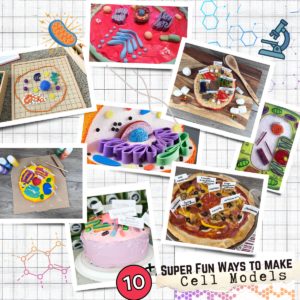
Whether your child needs a last-minute science project, wants to impress at the science fair, or simply learns best by building, making a cell model is one of the most memorable ways to explore biology. From edible cakes and cookies to LEGO creations, clay models, and printable projects, these ideas can help you choose the approach that fits your child’s age, learning style, and supplies you already have at home.
It doesn’t matter where they attend school – home, public, or private – at some point nearly every teen is going to take biology. When they do, the first thing they’ll likely study is the cell.
Don't be unsocialized! Click over to read the rest at Weird, Unsocialized Homeschoolers.
]]>
Train Up a Child With Intention in a World That Wants to Take That Job From You.
I saw the following question on a friend’s Facebook page recently, and I can’t seem to shake it…
Who (or what) is guiding our boys into manhood?
Because the truth is, if we are not intentional about how we train up a child, the world will be. And it is not lacking voices ready and willing to step into that space. The question is not whether our boys will be shaped… but by whom.
Train Up a Child With Intention in a World That Wants to Take That Job From You.
Don't be unsocialized! Click over to read the rest at Weird, Unsocialized Homeschoolers.
]]>
Learning Leads to More Learning
If you’ve never read The Secret Garden by Frances Hodgson Burnett, I highly recommend it for all children and parents. It is such a beautiful book about imagination, friendship, and the transformative power of caring for something beyond yourself. As Mary tends to the garden and learns about friendship, her heart and mind bloom in return. (Be sure not to miss the free Garden Unit Study and Lab workbook at the bottom of this article.)
It’s also a story that quietly asks a bigger question: what happens when you care for something long enough to watch it change?
Don't be unsocialized! Click over to read the rest at Weird, Unsocialized Homeschoolers.
]]>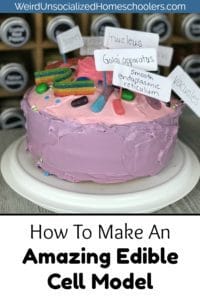
Learn how to make an edible cell model, using cake and candies, that looks as incredible as it tastes.
Making a cell model of some sort seems to be a universal rite of passage for middle and/or high school students. At some point during a biology unit, nearly every student is asked to build a model showing the parts of a cell. It’s one of those classic science assignments that shows up year after year in classrooms and homeschool science curricula.
Even if your science curriculum doesn’t assign a cell model project, you should consider doing one anyway.
Don't be unsocialized! Click over to read the rest at Weird, Unsocialized Homeschoolers.
]]>
Most of the time, when we introduce a new math idea, we explain it first and then look for examples.
A Pi Day study works better the opposite way.
A Pi Day Study That Starts With Curiosity
You start with something ordinary and slightly puzzling and let kids notice the rule hiding inside it.
- No vocabulary.
- No formulas.
- No pressure to understand yet.
Just a question and a piece of string.
(Don’t miss the link to the printable unit study at the end of the article to reinforce their Pi study.)
Using Everyday Objects to Spark a Pi Day Discovery
Walk into the kitchen and put a jar on the table.
Don't be unsocialized! Click over to read the rest at Weird, Unsocialized Homeschoolers.
]]>